
Getting “Second Summer of Love” on the road.
We talk to first time tour producer, Emmy Happisburgh of Contentment Productions, how she did it.
Finding your fit
I produce my own work. It’s hard work, I’m not going to sugar coat it. My advice to any young actors starting out is DO IT NOW! It took me until the age of 45 to start creating performance work for myself and I am fighting a battle to have enough energy every day. When you produce your own work you wear many hats and I think the only thing that has sustained me through it is that I am in love with this production and its message. That’s the first piece of advice I would give anyone preparing to tour you MUST be smitten with your project. For me, “Second Summer of Love” is the play I needed to see on stage; it answers questions I had about leaving my youth behind and entering mid-life as well as being “a joyous celebration of 90’s rave culture that will leave you uplifted and entertained” (Edfringe review). I have produced plays I’ve acted in before but this is the first piece I have felt propelled to share. I’m on a steep learning curve with my first tour but luckily I have friends with experience who have given me great advice.
I’d advise anyone who has a self-written/devised, fledgling, touring project to use scratch nights or work in progress nights and then showcase it at a fringe festival like Camden or Wandsworth or Edinburgh. Not every show goes to Fringe in the hope of immediately being the next “Baby Reindeer” or “Fleabag” some go as proofs of concept, a fully finished yet reduced version of what a production could be, a work-in-progress but a show in its own right. This helps gain audience and reviewer feedback to help development. Inviting reviewers to your show is ESSENTIAL. The Offie’s website has a list of the most respected reviewers they accept for OFFest as a jumping off point for invitations. 
After a work-in-progress night in SHORTs Festival at the Tritan Bates Theatre I took “Second Summer of Love” to Edinburgh Fringe as a one person show in 2022 as a cost-effective way to test the story-line and the concept. “Second Summer of Love” gained great reviews in Edinburgh but two of these reviews weren’t published until the last week, one was published on the last day (I read it as I came out of my last show) and the final one dropped a week after fringe had finished! However I am extremely grateful to those reviewers who came because it allowed us to add stars to our posters for future shows.
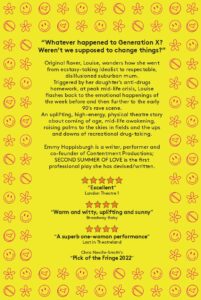
To tour you’ll need to present those stars and good reviews to theatre programmers to prove your show is viable for their box office. The Pleasance, where I performed in Edinburgh, are proactive in securing a future life for the projects. They hold events during the festival to put you in touch with receiving houses including “venue speed dating”. I got quite a few programmer contacts from Ellie at The Pleasance who was incredibly supportive. The Pleasance also collate information for shows which are available to tour after Edinburgh and send it out to various receiving houses. This is how my local professional theatre, the Yvonne Arnaud in Guildford, got in touch with me. I had wanted to perform there since I was a child!
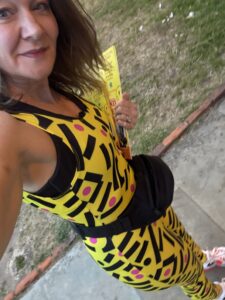
The other theatre I was keen to perform in was the Connaught Studio in Worthing. I didn’t know but I had already met their programmer, Gemma Curtis, on the street when I was flyering in costume in Edinburgh, and I enthusiastically “sold” her my show outside Pleasance Courtyard. Little did I realise what an important contact she would be. Gemma remembered me and my enthusiasm and offered me a slot at WTM when I contacted her. Programmers want to help those artists who are doing their best to help themselves. Hot tip – take your best-self and your energy to the streets in Edinburgh if you are showcasing your piece there – you never know who you are handing flyers to! With the indispensable feedback from Fringe I rewrote some scenes and had my new version directed by disproportionately talented director Scott Le Crass.
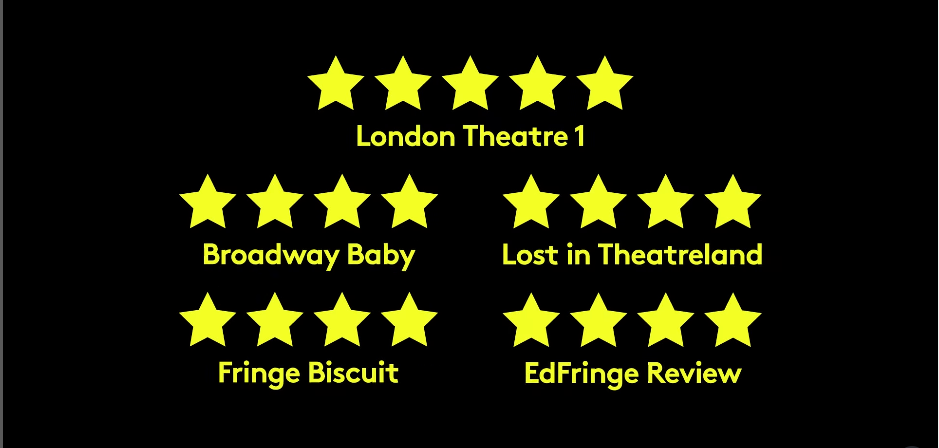
The new version was a hit, we sold out all three nights in Worthing and Guildford, had standing ovations (which I’m still not over) and although we only had one reviewer in, London Theatre 1, they gave us 5 stars. I decided to save up and schedule a national tour of this version of the show.
Budgeting
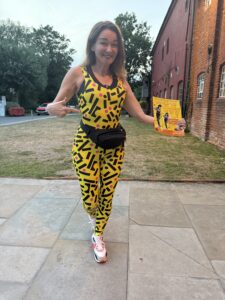
Funding is an essential component for a tour, unfortunately, options are limited. The Arts Council might consider you if you have a very detailed and broad outreach programme which runs alongside a worthy project. Other ways you might raise funds could be a gofundme or getting your script published to take on tour and sell. We are thrilled that Playdead press are publishing “Second Summer of Love”. You could also consider selling tour-branded merchandise like t-shirts, mugs, totes alongside scripts as friends may want to “support artists”. I have a merchandise partnership with Dance Wicked Clothing. Making partnerships with collaborators in the same genre (mid-life ravers for us) can help both of your projects.

I am not a funding expert and “Second Summer of Love” is currently independently funded from my acting coaching work. It has taken me two years to be in a position where I can fund it myself. What I do know is that when preparing a budget be mindful that marketing costs should take at least 10% of total budget; I cannot stress that enough.
Scheduling
I got in touch with my friend, Linus, at Awkward Productions for advice on a tour route – they had already been on several successful tours. They have a list of preferred studio theatres who had helped with promotion and tickets had sold well and I cross referenced it with programmers I’d met at Fringe. I produced my ultimate list of theatres and constructed an email to each of them with a tour pack which included photos, a video of the play, a synopsis, reviews, bios, technical details and even playlists. I was very lucky most theatres offered us a booking and I carved out a fourteen date tour including a five night London residency. Linus advised me when scheduling dates not to have back to back dates in cities far away from each other. First night shows on tour include a get in and then usually a tech run before you even perform, you’re in the theatre from 11am, sometimes earlier and travelling the night before or early that morning can leave you fatigued.
When scheduling dates you have to seriously consider personal circumstances. I’m a mother of two teens so I couldn’t tour during exam season. I also had to take into consideration my chronic illness. I have covid triggered Myalgic Encephalomyelitis (M.E.) so in the middle of the tour I have scheduled in a longer period of rest ‘just in case’. It’s a good idea to ask theatres for weekend slots which sell better; venues have given us Saturday nights and some Thursdays which are good “going out” nights. I started to schedule all of this nine months in advance because it’s essential to get this right to look after the well-being of the cast and to mitigate, as much as is possible, emotional stressors like fatigue or ticket sales when you’re on the road.
I would always advise to perform in theatres which offer a percentage split of ticket sales as much as you can so that both sides of the agreement are invested in selling tickets. Usual percentage splits are 70/30 or 60/40 at the smallest venues. A few of the larger theatres may offer a guaranteed minimum of approximately £400-£450 to perform there. I don’t think I’d be able to do the tour without those guarantees. The theatres really do have our backs as artists.
Linus also gave me the following advice, “contact friends you know in the areas you’re visiting to find out about those places. Our work is very queer and very fun so we contact friends local to the areas and ask them about the scene, gay bars and clubs where we might find our audience”. This is great advice I have followed for my own demographic of mid-lifers and ravers. If you have friends in the towns you are visiting you can also ask them if you can send them flyers to place strategically and you can ask if they will host you. A huge factor in making our tour affordable is the generosity of friends hosting us from York to Penzance. My daughter is in the cast so we share accommodation and my friend and other cast mate Christopher is also staying with friends. We are very grateful. Friend, actor, funny man and experienced tourer, Dana Haqjoo, likened one of his low budget touring digs to “staying in the equivalent of the Bates Motel”. I’m not sure it’s not quite that bad everywhere but it would be wise, if you don’t have friends in a town you want to visit, to ask theatres if they have a recommended digs list.
Technical
The good thing about travelling with your own technician is they know the show so you don’t have to teach the show to someone new at every venue. Some of the larger theatres have provided one or even two technicians/a board operator as part of the contract on this tour so we decided against taking our own to save on costs. Some of the smaller theatres don’t have a technician as part of the contract but they do have a list of trusted local technicians they can put you in touch with to discuss your needs. Recommended local theatre technicians are very skilled and reliable. I personally find running through the show with the technician and doing a tech run before a performance is a good warm up for keeping me sharp. If you bring a well-marked up technical script and have sound files loaded on QLab on a laptop a professional technician would be able to learn and operate the show in one day. However, for our five consecutive London dates at the Drayton Arms and our home gig in Cranleigh we are using the same techie as she’s a great company member, she lives a short travel from the venues and we don’t need to pay for a hotel room.

Tour Marketing
It is usual for the touring company to supply the theatre with print (posters and flyers) no less than three months in advance. Printed.com has competitive rates for good quality products and will send them directly to theatres. Popcorn Award nominated Anna Krauz of Passing Stranger Theatre Company, says, “I think it’s worth checking with particular venues what marketing they will give you and asking friends who tour what their experience with marketing was like at those venues” which is great advice.
Usually your receiving house will put you in their season brochure, host your ticketing page on their website and post about your show a few times on social media but they will have other shows to post about too. It is not unusual for them to offer paid ads in their brochure or on their social media and sometimes you will need to offer content such as reels for them to post – this is also a good way of building your relationship prior to your arrival. Linus and Joseph at Awkward are fans of the Instagram Story 24 hr Takeover. They’ll post funny clips shouting out to the theatre they are performing at next; it’s free direct marketing for your next venue and it also gives the theatre 24 hours off from having to post content too.
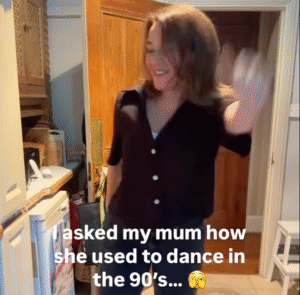
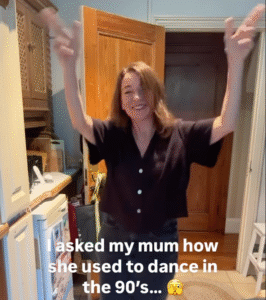
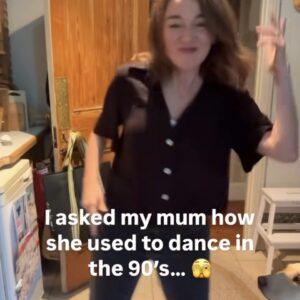
Nowadays so much of the venues’ and the touring company’s effective marketing takes place on social media. Connecting with your audiences whilst they are scrolling. I posted our flyer on a Birmingham facebook page recently and the community there got behind the post, that evening there was a sales spike for the local venue. These groups are usually moderated so people tend to react positively but as with all social media you have to be prepared for the odd weird comment! I also post reels. My daughter, who is a member of the company, recently made a reel of me raving in my kitchen which went viral (at time of writing we have 41,000 likes and 1.1 million views which is crazy). This has caused another small spike in ticket sales but you can’t pin your marketing strategy on a guarantee of going viral and often those numbers don’t convert into tickets anyway. It is a better strategy to pay for Instagram and facebook adverts because you can choose target audiences such as “theatre”, age groups and areas.
I still think the most effective flyering happens in person, when potential audience members you are handing your flyer to feel your enthusiasm. It is sensible to route your tour to some local theatres (three of ours on this tour are within driving distance to save on accommodation costs). This means you can exit flyer at the end of similar shows at those theatres in the weeks prior and also flyer local places which share your type of audience.
Press
Press Releases are very important but I have found different types of media need different releases – I have a few different ones saved. Local press can concentrate on the local interest of having “home grown talent”. For “Second Summer of Love” being at midlife as the lead character is also a selling point; an over 50’s website, restless.co.uk, recently did a lovely video feature on me as a dynamic mid-lifer thriving in my 50s! Music shows on the radio want to hear about the rave era and theatre podcasts want to hear about what it takes to bring a project to life. Each demographic requires a different press release to be useful to them for their copy or questions. The theatre community and rave community have been very generous with air-time for me. I have made a podcast with lovely Rob from Everything Theatre and phoned in an interview with awesome Keira EOC who DJs on Kane FM and BTN1 radio. I’ve also spoken with Ben Punter on BBC Norfolk and have a few more lined up. All of these chats were incredibly enjoyable and encouraged ticket sales. These work as “preview press” and are well worth doing.
I have invited more reviewers to this national tour and I have written over 100 press emails. I have five reviewers booked in and others who may confirm dates nearer the time which is really fantastic. I have a couple coming early on in the tour so hopefully that will help ticket sales for dates further along.
Many Hats
If you are self-producing it can be tricky to take your producer or writer hat off and solely concentrate on the rehearsing when the time comes. There is no point putting in all this work if you aren’t going to do your best work in performance and enjoy your time on stage. Justin Brett, another friend and Olivier winning member of the The Show Stoppers improv group said to me, “I have once in my life produced a show I was also in. I discovered that producing is financial and logistical spreadsheets, begging for favours and dealing with people moaning about things and asking for money that you don’t have. Unsurprisingly, I was proper shit in that show!” I can’t imagine Justin Brett being sh*& in anything but I do heed his warning. However, producing and writing my own work gives me a feeling of control which I have lacked in this industry through my twenties and thirties; it sure beats the helplessness of sitting around at home waiting for a callback. Touring has raised my profile in the industry, I’m meeting audiences (and making friends) miles away from home, I’ve created a piece of theatre with a message of unity and community and a soundtrack I love but best of all I get to practice my craft in a playful, energetic lead role. I feel very grateful to have been able to give that to myself.